Last updated:
- What you're holding: 100,000 Ultimate Rewards points. Cashed out through Chase Travel that's about $1,000. Transferred well — and the going rate among people who redeem these seriously agrees — it's closer to $2,050.
- Why Hyatt: it's still the only major hotel program with a published award chart. You can look up the price before you commit — which is exactly what makes planning a real trip around it possible.
- The new chart: since May 20, 2026, every category prices across five tiers (Lowest → Top). A Category 4 now runs 12,000–25,000 a night; a Category 8 runs 35,000–75,000. Your dates matter more than your hotel.
- The date to know: Chase drops Sapphire Preferred transfers from 1:1 to 4:3 on October 1, 2026 — and if you were approved on or after June 15, you're already there.
- The hidden discount: Hyatt charges no resort fees and no taxes on U.S. award nights. On a real Dream Nashville booking that's $90 of fees skipped on a single night — worth about 0.75¢ per point on its own.
- The one rule: transfer for a specific award you've already found. Never on a hunch, deadline or no deadline.
You did the thing. You applied in June or July, you put $5,000 through the card, the statement closed, and one morning the balance updated: 100,000 Ultimate Rewards points. It was the biggest bonus the Sapphire Preferred has ever offered, and a lot of people are watching it land right about now.
A note if you're arriving late: that 100,000-point offer ended in early August 2026, and the card now offers 75,000. Everything below still works — the destinations, the sweet spots, the math — you're just running it against a slightly smaller balance. Where a redemption needs more than you have, the "smart pick" for each region is the one to look at.
Then comes the harder part, which nobody warns you about. A hundred thousand points is enough to feel like it should become something extraordinary, and just vague enough that it's easy to fritter away on a $340 flight through the portal because you couldn't decide.
So here's the version we'd give a client: five destinations, and for each one, the aspirational pick and the pick that stretches the bonus into an actual vacation. Everything priced against Hyatt's new award chart. But first — there's a date you should know before you do anything.
First, the Date on Your Calendar
Chase is cutting the Ultimate Rewards-to-Hyatt transfer ratio from 1:1 to 4:3 on the Sapphire Preferred, the Ink Business Preferred, and legacy transfer-eligible cards. After the change, 4,000 Chase points become 3,000 Hyatt points — a 25% haircut on every point you send. We put that cut in context — and explain why the new Delta–Hyatt partnership doesn't offset it — in what the Delta and Hyatt tie-up means for your points.
Two timelines, and the second one catches people off guard. Existing cardholders keep 1:1 until October 1, 2026. But anyone approved for an affected card on or after June 15, 2026 is already transferring at 4:3, with no grace period at all. If you applied for the 100K offer this summer, that may well be you — which means the 100,000 points in your account are really 75,000 Hyatt points. (Applying now at the 75,000-point offer? Same 4:3 math, so budget about 56,000 Hyatt points.) Worth checking before you plan around the bigger number. We broke the whole change down, including whether upgrading to the Reserve is worth it, in our Chase-to-Hyatt 4:3 playbook.
What this does not mean is "dump everything into Hyatt before October." A deadline is a reason to decide faster, not a reason to decide worse. Points sitting in Chase can still become United miles, Air Canada Aeroplan, Virgin Atlantic points or a dozen other things; points sitting in Hyatt can only ever become a Hyatt night. Move what your trip actually needs, then stop.
What 100,000 Points Actually Buys
On May 20, 2026, Hyatt replaced off-peak/standard/peak with five pricing levels — Lowest, Low, Moderate, Upper and Top — inside the same eight categories. Hyatt has said it's rolling the two most expensive tiers out gradually, so through 2026 most nights still price in the bottom three. The practical effect: the same hotel can swing 40,000 points depending on the week you pick.
| Category | Lowest | Low | Moderate | Upper | Top |
|---|---|---|---|---|---|
| 1 | 3,000 | 4,500 | 6,000 | 7,500 | 9,000 |
| 2 | 6,000 | 7,500 | 10,000 | 12,000 | 15,000 |
| 3 | 8,000 | 12,000 | 15,000 | 17,500 | 20,000 |
| 4 | 12,000 | 15,000 | 20,000 | 22,500 | 25,000 |
| 5 | 15,000 | 20,000 | 25,000 | 30,000 | 35,000 |
| 6 | 20,000 | 25,000 | 30,000 | 35,000 | 40,000 |
| 7 | 25,000 | 30,000 | 35,000 | 45,000 | 55,000 |
| 8 | 35,000 | 45,000 | 55,000 | 65,000 | 75,000 |
Swipe the table sideways to see all five pricing levels.
That's the standard-room chart, straight off Hyatt's own published award page. Club rooms, standard suites and premium suites each have their own chart, and the all-inclusive resorts price separately on an A–F scale — a Category C all-inclusive like Hyatt Zilara Cap Cana runs roughly 20,000 to 40,000 points a night.
Read the spread rather than the middle. A Category 4 hotel is 12,000 points on its cheapest nights and 25,000 on its most expensive — the same room, twice the price, purely because of the date. On 100,000 points that's the difference between eight nights and four. A Category 8 swings from 35,000 to 75,000, which is the difference between three nights at a Park Hyatt and barely one. Nobody's award chart rewards flexible dates more than this one does right now.
Here's the part most "best ways to use 100K Chase points" roundups get wrong, and it's not a small thing: a lot of them still quote the old numbers — 12,000 for a Category 4, 40,000 for a Category 8 standard night. Those prices stopped existing in May. If a guide tells you 100,000 points is two and a half nights at the Park Hyatt Tokyo without mentioning that a busy week there can now price at 75,000 points a night, it hasn't been updated since spring. Check the date on anything you read about Hyatt this year, including this post.
The second thing worth knowing before you transfer anything: the bar a Hyatt redemption has to clear went up.
With that framework, the five trips. For each one: the property worth blowing the whole bonus on, and the one that turns 100,000 points into a week instead of a weekend. New to how the program works at all? Our complete World of Hyatt guide covers categories, elite tiers and the fifth-night-free rule from zero.
1. Stateside — Big Sur or a Full Week
The splurge: Alila Ventana Big Sur (Category 8). An adults-only property on the cliffs above the Pacific where recent median cash rates sit around $1,100 a night and summer weeks push well past $2,000. Award nights start at 35,000 points on the cheapest dates. Against that median that's roughly 3.1¢ per point; catch a peak week and it's far more. Either way it clears the bar comfortably, and it's one of the most reliably lopsided redemptions in the program. Your 100,000 points is two nights plus change. Award space is famously thin, so this one is about pouncing when it appears, not planning around it.
The smart pick: a Category 4 city hotel. Hyatt's April category reshuffle sent a handful of genuinely good properties down to Category 4, including Dream Nashville and the Hyatt Centric Congress Avenue in Austin. Category 4 is also the ceiling for those Category 1–4 free night certificates, so it's where a certificate and a points balance stack neatly. Dream Nashville is worth walking through in detail, because it shows exactly how the new chart behaves.
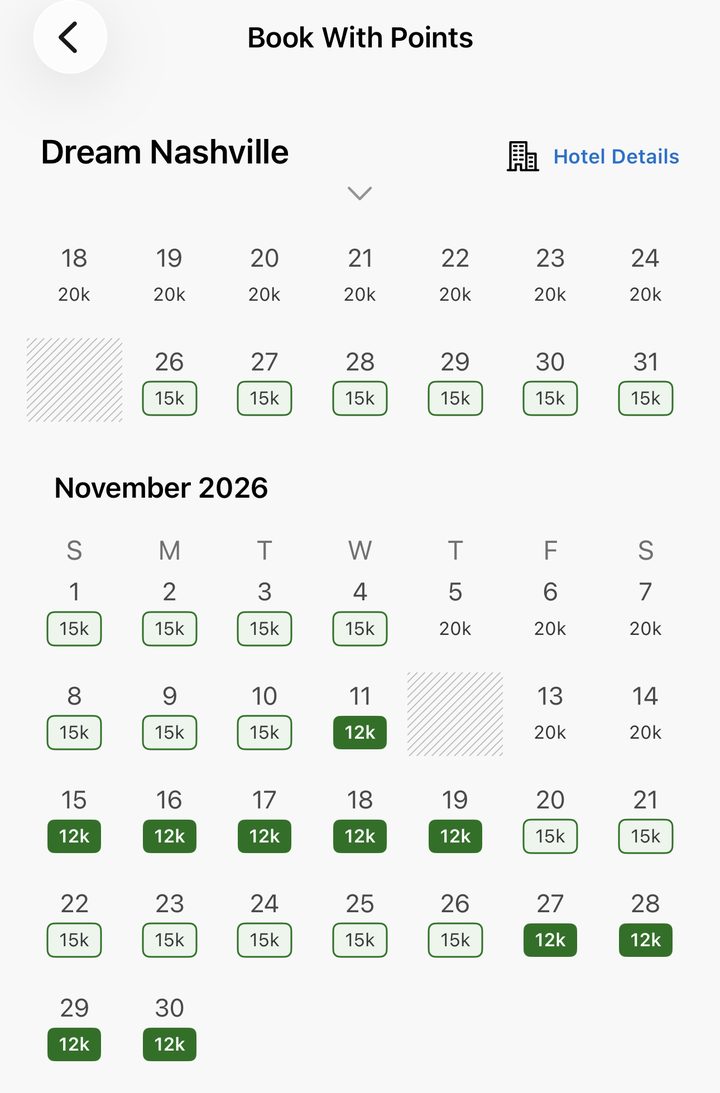
Look at what that calendar is telling you. Sunday November 15 prices at 12,000 points. Friday November 6 — nine days earlier, same room, same hotel — is 20,000. Shifting the trip by a week and a half saves 8,000 points a night, which across a four-night stay is 32,000 points. That's a third of the entire welcome bonus recovered by moving the dates, and it's the single highest-leverage decision you'll make in this whole process.
Now the other half of the equation: what that 12,000-point night would have cost in cash.
The Part That Doesn't Show Up in the Points Price
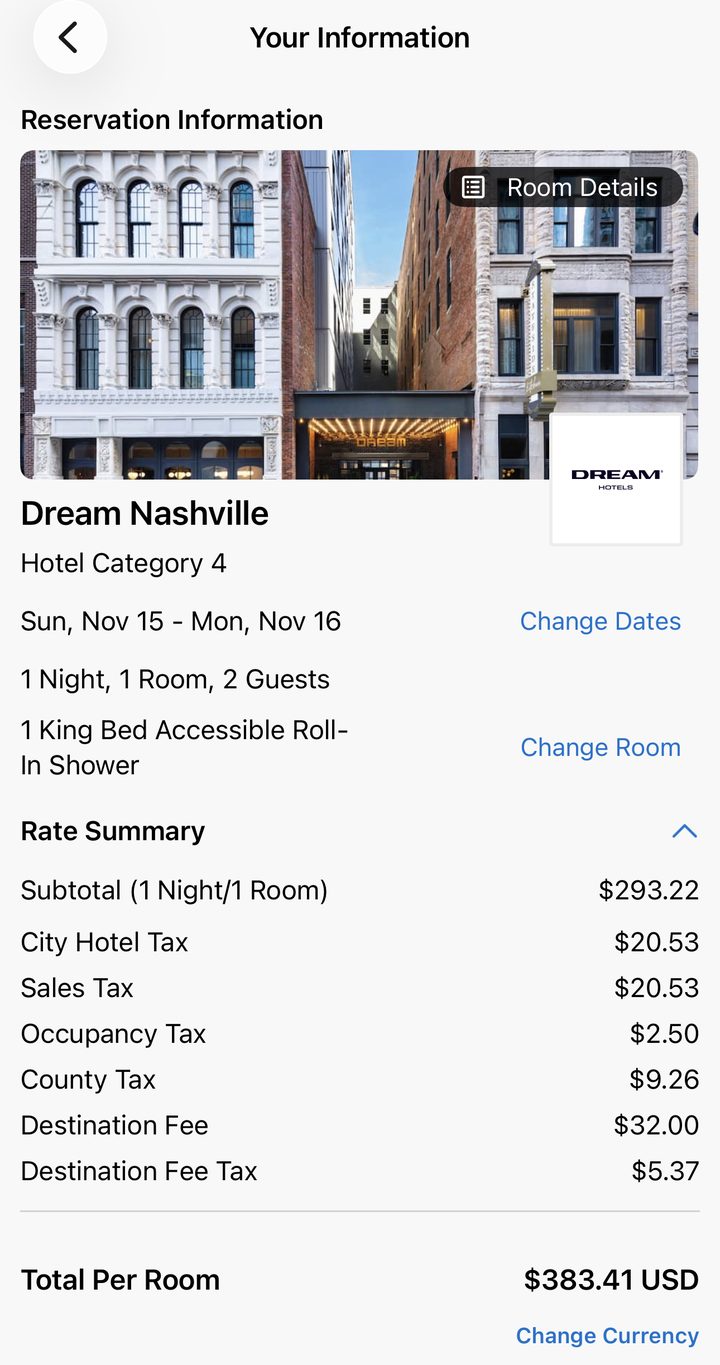
That Dream Nashville screen is worth staring at, because it contains the most underrated argument for the whole program. The room is $293.22. The total is $383.41. In between sit $20.53 in city hotel tax, $20.53 in sales tax, $2.50 in occupancy tax, $9.26 in county tax, a $32.00 destination fee, and $5.37 of tax on the destination fee.
Book the identical night with points and you pay none of it. Hyatt doesn't charge resort or destination fees on award stays — a policy Marriott and Hilton have both chipped away at — and a domestic Hyatt award night generally comes to $0.00 at checkout. No room tax, no county tax, no $32 daily fee for a lobby you were going to walk through anyway.
Run the two numbers side by side and it changes the math more than most people realize. Against the room rate alone, 12,000 points for $293.22 is 2.4¢ a point — respectable, nothing special. Against the number you'd actually have paid, it's 3.2¢ a point. The fees and taxes you skip are worth roughly 0.75¢ per point on their own, which on this booking is nearly a third of the total value. Every cents-per-point figure you see quoted against a bare room rate is understating Hyatt by about that much.
One honest caveat: this is cleanest in the United States. Several countries levy accommodation taxes that are owed on award stays too — Japan's lodging tax and various European city taxes among them — so a Tokyo or Paris award night may still come with a small local charge at checkout. It's usually a few dollars a night, not ninety.
2. Europe — Place Vendôme or a Week in Lisbon
The splurge: Park Hyatt Paris-Vendôme (Category 8). The one everybody saves for. Median cash rates run around $1,700 a night, and awards start at 35,000 points — roughly 4.8¢ per point, which is about as good as hotel points get. Two nights and you've used most of the bonus; two nights at the Park Hyatt Paris is also a completely reasonable way to spend a 100K welcome bonus, and we'd have a hard time talking anyone out of it.
The smart pick: Hyatt Regency Lisbon (Category 5). Fair warning — this one moved up to Category 5 in the May reshuffle, so it's no longer free-night-certificate eligible. But at 15,000–25,000 points on most dates against cash rates that often sit in the $200–$300 range, it still lands right around the bar, and 100,000 points is roughly five or six nights — closer to seven if every date prices at Lowest — in a city that's currently one of the better-value capitals in Western Europe. If London is on the same itinerary, our guide to the best Central London hotels for points runs the same math on a much more expensive market.
3. The Caribbean — Where All-Inclusive Wins
The splurge and the smart pick are the same hotel here, which is what makes the Caribbean the most efficient use of this bonus. Hyatt's all-inclusive resorts price on their own A–F chart, and Hyatt Zilara Cap Cana in the Dominican Republic sits at Category C: 20,000 points a night on the cheapest dates, up to 40,000 at the top.
The reason all-inclusives punch above their weight on points is that the award night includes what you'd otherwise spend on top of the room — meals, drinks, most activities, for two people. A comparable cash stay for two commonly runs $500–$700 a night once you account for that, which puts a 20,000-point night around 2.5–3.5¢ per point, clearing the bar even after the transfer cut. On 100,000 points you're looking at a four-to-five night adults-only week where you don't open your wallet again after you land. The Ziva properties are the family-friendly equivalent at similar pricing.
One stacking note worth acting on: Hyatt is running a promotion that hands you a Category 1–4 Free Night Award for every three nights in Latin America and the Caribbean, and registration closes September 30. If your Cap Cana trip is happening anyway, registering first is free money — we covered the terms in our breakdown of the Latin America free-night offer.
4. Tokyo — The Icon or Five Nights in Ginza
Tokyo deserves more than one line right now, because it is comfortably the most-wanted city on this list. A weak yen has made Japan the trip everyone is trying to take, cash hotel rates in the good neighborhoods have climbed accordingly, and Hyatt happens to have unusually deep coverage there — which is exactly the combination that makes points worth spending rather than hoarding. Three properties are worth knowing.

The splurge: Park Hyatt Tokyo (Category 8). The Lost in Translation hotel, the New York Bar on the 52nd floor, the whole thing. Cash rates regularly clear $700–$900 a night. Awards start at 35,000 points, which works out to roughly 2.3–2.6¢ per point — a clear win at 1:1, and still workable at 4:3 if you catch a Lowest-tier date. Peak weeks are the problem: a Category 8 top-tier night is now 75,000 points, and at that price the math collapses. This is a redemption you plan around the calendar, not the other way round.
The smart pick: Hyatt Centric Ginza (Category 6). At 20,000–40,000 points against cash rates typically in the $350–$450 range, it hovers right at the bar rather than sailing over it — but on the cheapest dates it puts you in Ginza for five nights instead of Shinjuku for under three. If the trip is the point rather than the room, that's the better trade.
The one for families: Hyatt House Tokyo Shibuya (Category 6). This is the quiet standout, and the property we'd point most people toward. It's new, it's about a five-minute walk from Shibuya Station — which puts basically all of Tokyo one train ride away — and the rooms are the thing: genuinely large by Tokyo standards, with a kitchenette and an in-room washing machine. If you've ever tried to fit a family of four into a 21-square-metre Tokyo hotel room, you understand immediately why that matters. It prices in the same 20,000–40,000 band as the Centric, so 100,000 points is four or five nights with room to spread out and do laundry halfway through a two-week trip. The catch is award space: it's popular enough that the good dates go early, so search it the moment your plans firm up.
And if you'd rather aim your Chase points at getting to Tokyo than staying in it, the flight side is often the stronger play — a fair question to ask before you transfer a single point to a hotel.
5. Hawaii — The Best Value on This List
The splurge: Andaz Maui at Wailea (Category 8). Beachfront, four pools, and cash rates that sit between $800 and $1,200 before the resort fee — which Hyatt waives on award stays, a quietly meaningful perk in Hawaii where those fees run $50 a night. At 35,000 points on the lowest dates that's around 2.6¢ per point plus the fee waiver. Grand Hyatt Kauaʻi is the same category and the same calculation on a different island.
The smart pick: Hyatt Regency Maui (Category 6). 20,000–40,000 points a night against cash rates that commonly run $500–$700 in season, plus the same fee waiver — call it 3¢ per point on a good date. A hundred thousand points is five nights on Kaʻanapali Beach, which is a real Hawaii vacation rather than a long weekend.
The one we'd actually book: Hyatt Place Waikiki Beach (Category 4). We've stayed here, and it's the reason we keep telling people Hawaii is more reachable on points than they think. It's Category 4 — 12,000–25,000 points a night — on Oʻahu, the island most first-timers actually want, a couple of blocks off Waikiki Beach and in the middle of everything. Breakfast is included, and the fee-and-tax waiver hits especially hard in Hawaii, where resort fees and the state's lodging taxes can add $60–$80 a night to a cash booking.
Do the arithmetic on that and it's the most quietly impressive number in this post: on the cheapest dates, 100,000 points is eight nights in Waikiki. Not a weekend, not a splurge you'll be paying off — eight nights, breakfast included, nothing owed at checkout. If Hawaii has been the trip you keep putting off because the numbers never worked, this is the one that makes them work.
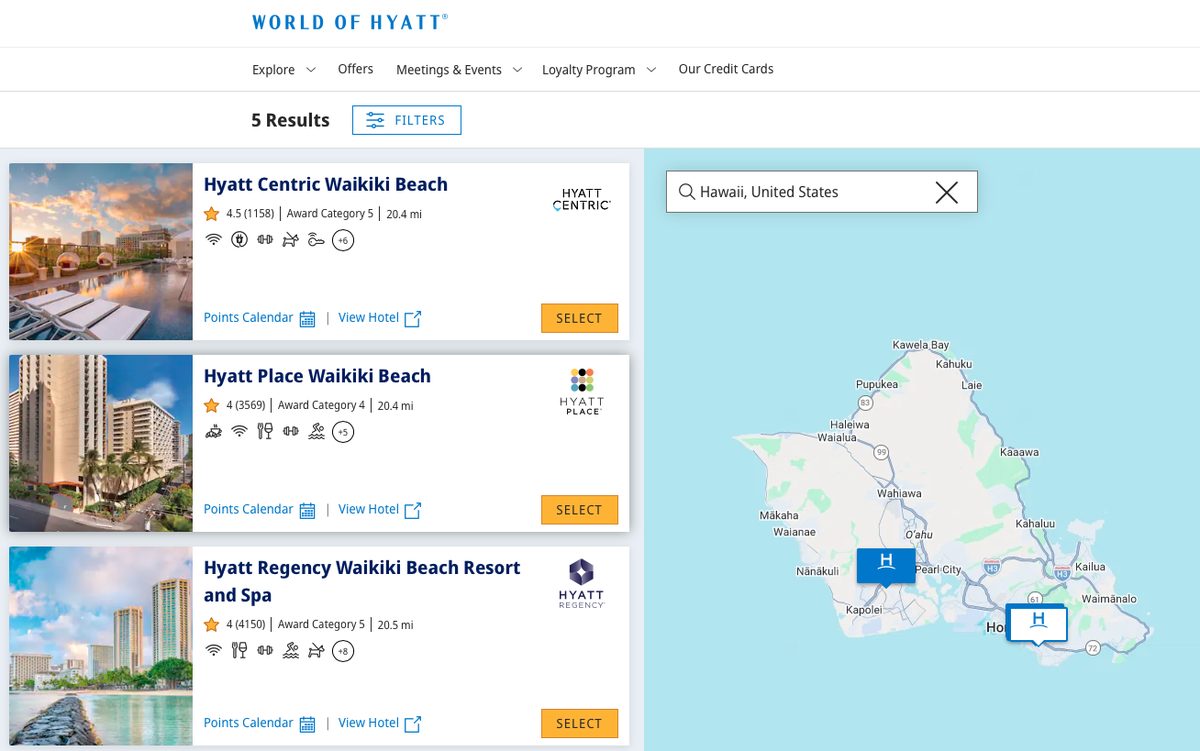
That search screen is worth two observations. The first is how much work Hyatt does for you: the Award Category is printed right there in the results, next to the star rating, before you've clicked into anything. You can scan an entire island and know what every property will cost you. Marriott and Hilton simply cannot show you that, because they don't have a chart to show.
The second is the number at the top: five results for the entire state. Hyatt's Hawaii footprint is small, and three of those five are clustered in Waikiki — the Place at Category 4, plus Hyatt Centric Waikiki Beach and the Hyatt Regency Waikiki Beach Resort and Spa at Category 5 (15,000–35,000 points). Small footprint means competitive award space, which means the Hawaii redemptions on this list reward booking early far more than the mainland ones do. Hyatt opens its calendar about 13 months out. If your dates are firm, search them now.
The best redemption isn't the most expensive hotel. It's the one you'd have paid cash for anyway.
That last line is the whole discipline. A 4.8¢-per-point night at the Park Hyatt Paris is only worth 4.8¢ if you were ever going to spend $1,700 on a hotel room. If you weren't, you didn't save $1,700 — you spent 35,000 points on a room you'd have replaced with a $220 one. Five nights on Maui you'd genuinely have booked is a better outcome than two nights somewhere you're admiring mostly because the cash rate is absurd. For more redemptions in this range, our guide to booking a $600 hotel for under 20,000 points works through the math property by property.
If Hyatt is going to be your main redemption engine for years rather than one trip, the Chase Sapphire Reserve is the only Sapphire card that keeps 1:1 Hyatt transfers after October 1 — though at $795 a year versus $95, that ratio alone needs you moving north of 100,000 Hyatt points annually to pay for itself. We ran that comparison in full in should you hold both Sapphire cards. And if the goal is simply more Ultimate Rewards to work with, pairing the Preferred with the no-annual-fee Freedom Unlimited or Freedom Flex is the standard way to build the balance faster without another fee.
How to Actually Book It
Finding the redemption is the fun part. Executing it is where people lose points, so the order matters:
One. Search the award on hyatt.com first, with the "Use Points" toggle on, before you transfer anything. Confirm the exact dates, the exact room type, and the exact points price. Two. Note whether the price shown is Lowest, Low or Moderate — shifting your trip by three days is often worth 10,000 points a night. Three. Only then transfer, and transfer only what that booking needs. Four. Book immediately; Hyatt award space at the good properties disappears in hours, not days.
A walkthrough is coming. We're publishing a companion post next that goes through the Hyatt booking flow screen by screen — the points toggle, reading the five-tier calendar, confirming the transfer landed, and locking the reservation — using real screenshots from an actual booking at one of the properties above. If you'd rather see it than read it, that one's for you.
The Bottom Line
A hundred thousand Chase points is a genuinely large amount of currency, and World of Hyatt remains the most transparent place to spend it — you can look up the price of a room before you commit, which is more than Marriott or Hilton will give you.
What's changed in 2026 is that "transfer to Hyatt" stopped being an automatic answer. The May chart raised prices at the top, October 1 raises the cost of getting there, and the valuations most of us work from now put a Chase point above a Hyatt point. That doesn't make Hyatt a bad idea. It makes it a decision — one that pays off beautifully at Cap Cana, at the Park Hyatt Paris on a quiet week, at the Hyatt Regency Maui in shoulder season, and less well almost everywhere you'd transfer without looking first.
So: pick the trip. Find the dates where it prices at Lowest or Low. Confirm the award is bookable. Then move exactly the points it takes, and go. That's the entire strategy, and it's worth considerably more than any list of twenty-one redemption ideas. And if you're still building toward that 100K balance, the everyday earning matters too — our guide to the Q4 2026 Chase Freedom categories shows how a quarter of grocery and dining spend quietly becomes thousands of transferable points.


